
You can improve food security in Guatemala with your own hands, in the highland villages where the need is felt daily.
Shifting the travel paradigm away from passive sightseeing toward structured agricultural construction provides an immediate antidote to localized resource scarcity. This active operational framework targets systemic hunger at the household level while providing volunteers with direct visibility into community-led resilience.
Keep reading to learn how your journey can plant seeds of change for a family and for yourself.
The Lasting Lessons of Volunteer Service
The core lessons are simple and lasting:
- Seeing Systems, Not Symptoms: You will learn that food security is about stable access and nutrition, not just handing out meals.
- The Power of Partnership: Your work supports existing community plans, building on local knowledge and strength.
- A Renewed Sense of Purpose: You will come home with stories of specific families and a clear picture of how steady support creates change.
What Is Food Security in Guatemala? It’s More Than a Meal
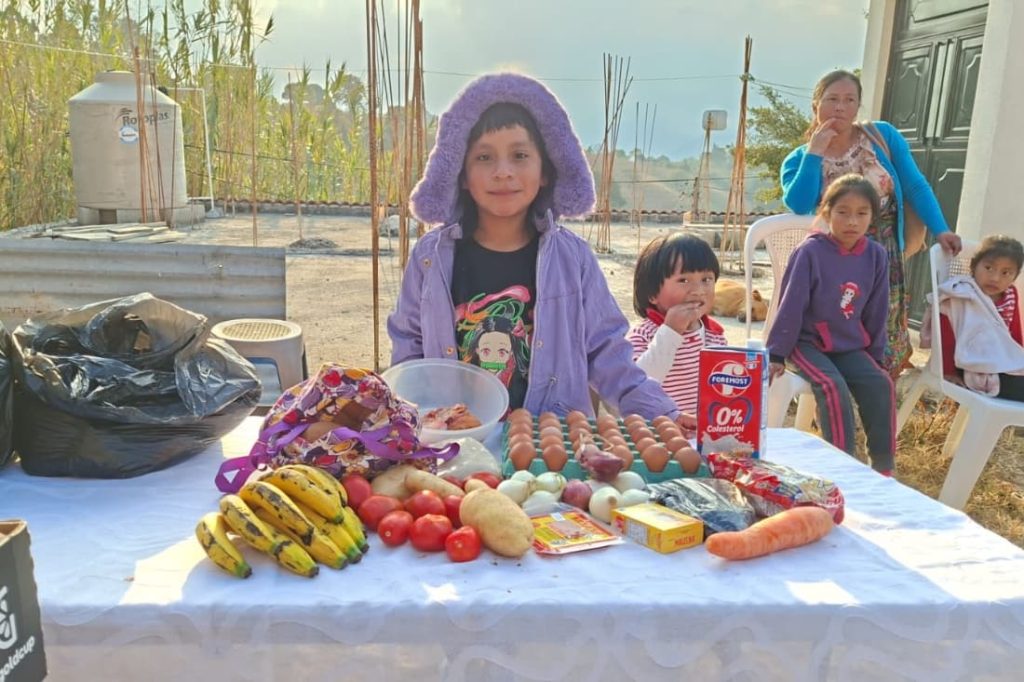 Securing food in a region means dealing with unstable local market prices and high transport costs. Setting up home-based, high-yield garden beds gives a household steady access to clean produce. This protects children from sudden price jumps in basics like black beans and corn.
In the rural highlands around San Andrés, at 7,047 feet, food security is a daily calculation. It is not an idea used by aid groups for the families you will meet. It is the quiet worry of the canícula, the mid-summer drought, and whether the corn will last until the next harvest.
You see it in the careful way a grandmother divides a pot of soup, in the focus of a child in a school feeding program.
Data from Maternal & Child Nutrition demonstrates
“Guatemala’s rural indigenous population suffers from one of the highest rates of chronic child malnutrition (stunting) in the world.” – Maternal & Child Nutrition
This is the reality you step into. It is complex, layered with history and weather, and it helps you understand food security in Guatemala beyond statistics. It is the reason your presence matters. You are not there to fix it in a week. You are there to see it, to support the local work that is already growing from the ground up.
How to Define Guatemala Food Security Through Partnership?
 You can define it by what it lacks: consistency. In a country that ranks sixth in the world for long-term malnutrition, food security is fragile. It is seasonal work that dries up, it is a single cash crop failing, it is a child’s growth stunted before age five.
But you can also define Guatemala food security by what builds it: partnership. That is the frame Be Humanitarian uses. Food security is built by supporting a family’s ability to provide for itself, year-round.
What Builds Food Security
It is:
- The garden tower that gives 1,250 meals a year from a few square meters.
- The water filter that stops the illnesses that keep a child from absorbing nutrients.
- The sponsorship that makes sure a child gets breakfast and lunch at school, so they can focus on their lessons instead of their hunger.
Your role as a volunteer is to strengthen these existing systems. You might spend a morning helping to put together a garden tower, your hands in the soil next to a local farmer.
Successful field execution relies entirely on reinforcing pre-existing indigenous agricultural systems rather than introducing incompatible foreign tech.
Integrating volunteer physical labor under the explicit direction of local farmers guarantees that the constructed infrastructure remains structurally viable and fully maintained long after foreign teams exit.
Why Is Food Security Critical in Guatemala?
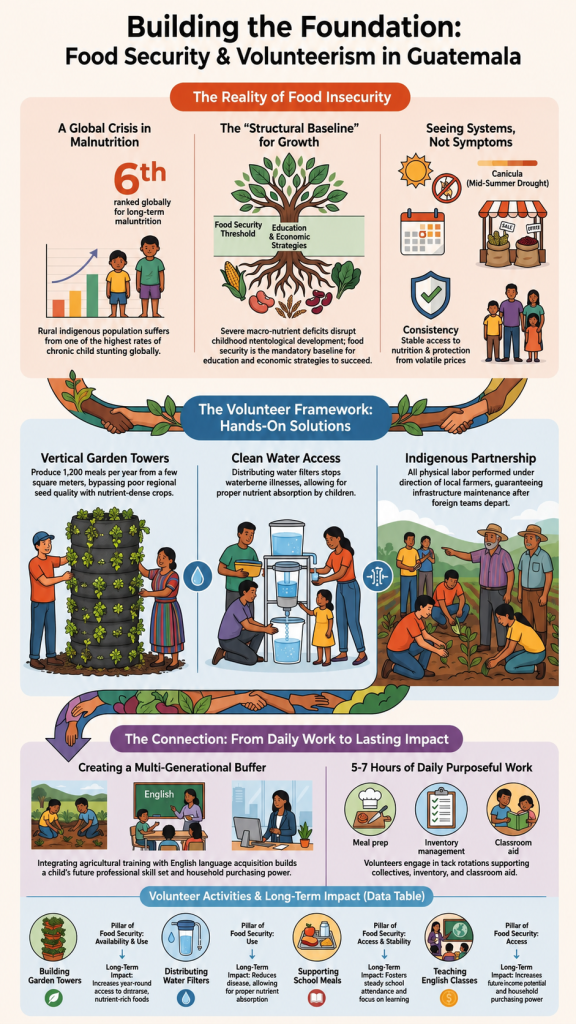 Severe macro-nutrient deficits fundamentally disrupt early childhood neurological development and metabolic health.
Addressing these caloric shortfalls serves as the mandatory structural baseline required for any subsequent educational or economic development strategy to succeed.
It is about a generation’s lost potential. Understanding why food security is critical becomes clear because it is the absolute base for everything else: education, health, economic stability. Without it, efforts in other areas are like building a house on sand.
This is why the work feels so urgent and basic. For retired volunteers or professionals looking for meaningful work, this is the core issue.
You are not painting a school that might lack nourished students. You are working on the foundation that allows that school, and that child, to thrive.
The critical need makes the shared laugh over a planted seed, the high-five after a game, so deep. You are dealing with the most essential human need, and in doing so, you are seeing the shared humanity that makes it necessary to act.
How Is the Path to Improving Food Security in Rural Guatemala?
Credits: Be Humanitarian
Improving food security in rural Guatemala is not a single project, it is a collection of small, steady actions. In rural Guatemala, it starts at the household level. Your volunteer days are built around these real, community-asked actions that add up to true strength.
As highlighted by The Journal of Climate Change and Health
“Community-led strategies must be supported by responsive, well-resourced public institutions.” – The Journal of Climate Change and Health
You will typically have five to seven hours of involved, purposeful work. Operational task rotations alternate between supporting indigenous women’s collectives with the preparation of high-protein, cost-effective regional meals and managing the inventory distribution of critical educational supplies.
A Week Supporting Food Security
To give you a clearer picture, here is what a week might include:
- Building Family Gardens: Putting together raised garden beds and planting vegetable seedlings.
- Supporting Nutrition Education: Helping local health workers show how to make healthy recipes.
- Improving Water Access: Handing out and explaining how to use water filters.
- Aiding School Programs: Volunteering in a classroom or helping at a school feeding program.
You relax after dinner, the cool mountain air is a relief, your muscles tired from good work. The trip is guided by Be Humanitarian’s founder, Tobie Spears, and her local team, making it easy to travel with us while supporting long-term community partnerships. This makes sure your efforts are safe, respectful, and fit into long-term partnerships.
They have had volunteers over 70, though the high elevation needs a doctor’s check for anyone with heart or breathing concerns. A nearby clinic is always known, and an experienced guide is with you the whole time.
How Does Volunteer Work Connect to Lasting Food Security?
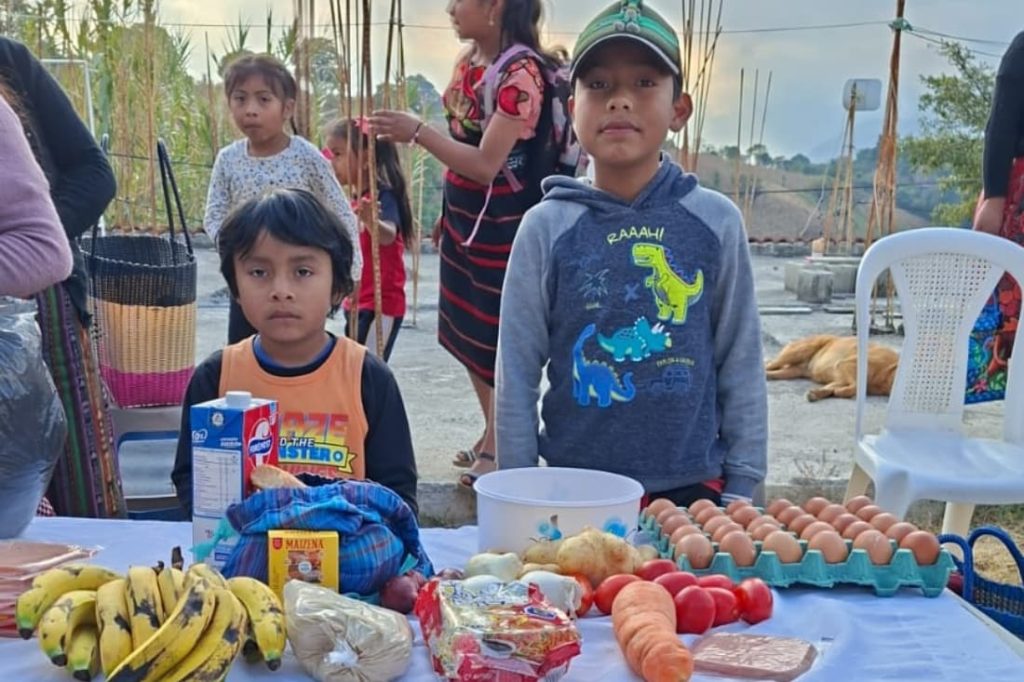 The link between your hands-on work and long-term food security is direct. Each activity you support is a thread in a larger cloth of stability.
To see how your daily efforts help the bigger parts of food security, look at this breakdown:
| Volunteer Activity | Pillar of Food Security It Supports | Long-Term Impact |
| Building Garden Towers | Availability & Use | Increases household access to diverse, nutrient-rich foods all year. |
| Distributing Water Filters | Use | Reduces waterborne disease, letting children absorb nutrients from food. |
| Supporting School Meals | Access & Stability | Gives reliable daily food, allowing steady school attendance and learning. |
| Teaching in English Classes | Access | Builds future skills for better income, improving a family’s ability to buy food. |
Utilizing vertical garden towers allows households to cultivate nutrient-dense crops like Swiss chard, native amaranth, and spinach while bypassing poor regional soil quality.
Integrating introductory language acquisition alongside primary agricultural training builds a multi-generational economic buffer.
Expanding a youth’s professional skill set directly correlates with increased future household purchasing power and long-term regional food access. Your work, combined with steady sponsorship donations, creates a compound interest of hope and stability.
FAQ
How can I continue helping after my volunteer trip ends?
Post-trip sustainability relies on transitioning from manual labor to recurring programmatic funding. Enrolling in a structured monthly sponsorship ensures that the specific families met during field construction receive an uninterrupted supply of school materials, medical checks, and agricultural inputs year-round.
Can I sponsor a child after volunteering in Guatemala?
Yes. Many volunteers choose to sponsor a child in Guatemala after completing a mission trip because they want to continue supporting the child and community they served.
A sponsorship program often includes sponsor updates, letters from sponsored children, and impact stories. This relationship-based giving supports child development and creates a meaningful sponsor journey.
Who can join volunteer opportunities in Guatemala?
Volunteer opportunities in Guatemala welcome adults from many backgrounds, including older professionals, retired volunteers, students, and working professionals. You do not need previous volunteer experience to participate.
A willingness to learn, show compassion, and work alongside local families allows you to make a difference through practical humanitarian support.
How do volunteering and sponsorship work together?
Volunteering provides immediate humanitarian support during your trip, while monthly sponsorship continues helping families after you return home. Together, they strengthen child welfare, youth support, family empowerment, and poverty alleviation.
This combined approach creates sustainable change, strengthens community partnership, and delivers lasting impact through trust and transparency.
Why do many people find this work emotionally meaningful?
Many volunteers experience emotional fulfillment because they see how their time and effort help local families. Through compassionate giving, generosity, and meaningful giving, they help create hope and opportunity for children.
Whether you sponsor a family, sponsor children, or continue giving back, your support contributes to lasting social good.
Keep Making A Difference In Guatemala
Your impact doesn’t end when your trip is over. The garden towers keep growing, and the children you met continue to receive meals and education. Many volunteers choose to keep helping by sponsoring a child. What starts as one meaningful trip can grow into long-term support that helps a family build a brighter future.
If you want your volunteer experience to keep making a difference, Be Humanitarian makes it easy to stay involved. Learn how you can support a child in Guatemala and create a lasting impact.
References
- https://pmc.ncbi.nlm.nih.gov/articles/PMC6860048/
- https://www.sciencedirect.com/science/article/pii/S2667278225001026